Most adults need roughly 1.5 to 2 litres of fluid from drinks on a normal day, a bit more for men than women, and more again when you move a lot or it is hot. The famous "2 litres of water a day" is a decent rough guide, not a rule, because food also gives you water and coffee and tea count too. The simplest check is your own body: you are rarely thirsty and your urine is pale yellow.
That is the short answer. Here is how it actually works, and how to figure out what makes sense for your day, whether you spend it at a desk, on a bike or both.
What the official recommendation says
The European Food Safety Authority (EFSA) sets an adequate intake of total water of about 2.0 L a day for women and 2.5 L a day for men. The key word is total. That figure includes water from everything: tap water, coffee, tea, milk, soup, and the water inside your food.
Food usually covers around 20% of it. Fruit, vegetables, yoghurt, pasta, rice and soups are all mostly water. So the part you actually drink is lower than the headline number:
- Women: roughly 1.6 L from drinks on a normal day
- Men: roughly 2.0 L from drinks on a normal day
These are averages for adults living a fairly quiet life in a mild climate. They are a starting point, not a target you have to hit to the millilitre.
Is the "8 glasses a day" rule a myth?
Half myth, half useful. Eight glasses of about 250 ml add up to 2 litres, which lands close to what many adults need from drinks. As a rough rule to remember, it is not bad.
Where it goes wrong is when people treat it as law. It does not account for the water in your food, it ignores the coffee and tea you already drink, and it says nothing about the day you cycle 60 km in July. Some people will need less, others clearly more. Use it as a reminder to drink regularly, not as a box to tick.
What changes how much water you need
Your needs move around from day to day. The main things that push them up:
- Activity: the more you move and sweat, the more fluid you lose. A padel match, a long run or a day of moving house all count.
- Heat and humidity: warm weather means more sweat, even if you are just walking around town. Heated, dry offices in winter can also leave you thirstier than you expect.
- Body size: bigger bodies generally need a bit more water than smaller ones.
- Pregnancy and breastfeeding: needs go up during both. Ask your doctor or midwife what is right for you.
- Illness: fever, vomiting or diarrhoea all increase fluid losses. If you have a medical condition, such as kidney or heart issues, talk to your doctor about how much to drink, because the general advice may not apply to you.
Do coffee, tea and other drinks count?
Yes. This one surprises a lot of people. The mainstream view is that coffee and tea, in normal amounts, count towards your daily fluid intake. Caffeine has a mild diuretic effect, but you still keep most of the water you drink. Your morning coffee is not dehydrating you.
The same goes for milk, herbal tea, sparkling water, soup and most other drinks. Water is still the easiest everyday choice: it is free, has no sugar, and you can drink as much as you like. Sugary drinks and alcohol are the ones to keep in check, for reasons that have more to do with sugar and alcohol than with water.
How to tell if you are drinking enough
You do not need an app or a spreadsheet. Two simple checks work for most healthy adults:
- Thirst. For most people in daily life, thirst is a reliable signal. If you drink when you are thirsty, you are usually in a good place.
- Urine colour. Pale yellow, like light straw, is what you are looking for. Dark yellow suggests you could drink more. Completely clear all day long can mean you are drinking more than you need.
Other hints that you are running low: a dry mouth, headaches that go away after a glass of water, or feeling sluggish in the afternoon. They can have other causes too, but water is an easy first thing to try.
Example days: how your needs can change
Here is what this looks like in practice. These are rough, qualitative guides, not prescriptions. Everyone is different, so let thirst and urine colour have the final say.
| Type of day | What it looks like | What to aim for |
|---|---|---|
| Office day | Desk work, a short walk, mild weather | Around the baseline. Water or tea through the day, a glass with each meal, coffee counts. |
| Active day | A 45 to 60 minute run, gym session or padel match | The baseline plus some extra before and after training. Drink to thirst during the session. |
| Hot training day | Longer effort in the heat, lots of sweat | Clearly more than usual, spread out over the day. Think about replacing salt as well as water, not only plain water. |
On those sweatier days, you lose more than water. Sweat also contains electrolytes, mostly sodium, plus smaller amounts of potassium and magnesium. If you want to know when plain water is enough and when something with electrolytes makes sense, we cover that in electrolytes vs water.
Can you drink too much water?
It is rare, but yes. Drinking very large amounts of plain water in a short time can dilute the sodium in your blood. This is called hyponatremia, and it can be serious.
For everyday life, it is not something to worry about. It mostly shows up during long endurance events, such as marathons or long triathlons, when people drink far more plain water than they lose in sweat, often because they were told to "drink as much as possible". The practical takeaway is simple: drink to thirst, do not force litres down, and on very long or hot efforts, include some sodium rather than only plain water. If in doubt, talk to a doctor or a sports dietitian.
Small habits that help you drink more
If you know you tend to forget, a few small habits do more than any big plan:
- Keep a bottle on your desk. If it is in sight, you will drink from it. Refill it at lunch.
- Drink with every meal. A glass of water at breakfast, lunch and dinner already covers a good part of your day.
- Start the morning with a glass. Before or alongside your coffee.
- Pack water in your sports bag. So it is there before, during and after training.
- Make it something you like. Sparkling water, a slice of lemon, herbal tea. Whatever makes you reach for it.
- Eat your water. Fruit, vegetables and soups all add up.
Where Maverick fits in
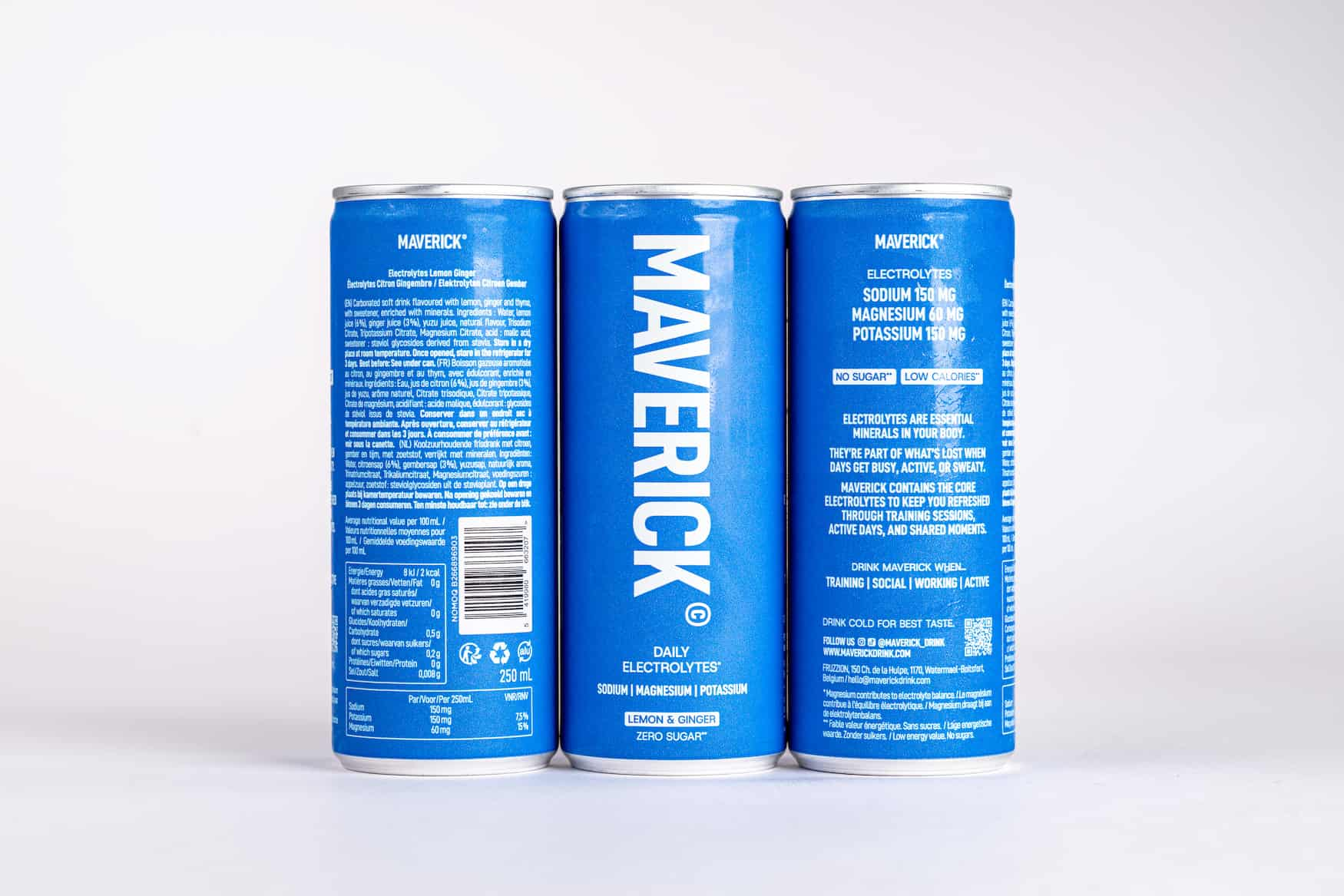
On most days, water does the job. On active days, some people like to have something with a bit more to it. That is where Maverick can be an easy option: a 250 ml lightly sparkling can with sodium, potassium and magnesium, 5 kcal and no added sugar. The magnesium contributes to electrolyte balance and to normal muscle function. You can read more about what is inside and why.
It is not a must, and it does not replace water. Think of it as one of the drinks in your day, next to your water bottle. For very long, very hot efforts, you may need more sodium than one can gives. If you want to try it, you can find it in the shop.
There is no perfect number that fits everyone, and that is fine. Keep a bottle nearby, drink with your meals, listen to your thirst and glance at the colour now and then. Small, steady habits beat any strict rule, and they leave you free to enjoy the walk, the run or the ride.