Reading a sports drink label takes about thirty seconds once you know where to look. Check five things: sugar per serving, the sweetener, the electrolytes in mg and %NRV, calories and caffeine, and the order of the ingredients. That is enough to tell a sugar free sports drink that suits your day from one that is basically lemonade with a sporty font.
Let's go through each step, using our own can as the worked example, so you can do the same with any bottle in the fridge at the supermarket or the padel club.
Step 1: Check sugar per serving, not just per 100 ml
In the EU, every nutrition table shows values per 100 ml. That is useful for comparing products, but it is not what you actually drink. Many labels also give a figure per serving, and that is the one that matters.
Here is the classic trap. A bottle says 6 g of sugar per 100 ml. Sounds modest. But the bottle holds 500 ml, so you are drinking 30 g of sugar, which is roughly seven or eight sugar cubes. Nothing on the label is wrong, it just asks you to do the maths.
So the quick habit is: find the sugar line, find the bottle size, multiply. A few other things worth knowing:
- "Sugar free" on an EU label means no more than 0.5 g of sugars per 100 ml.
- "No added sugars" means nothing was added, but there can still be a little natural sugar from fruit juice.
- "Of which sugars" under carbohydrates is the line to read, not total carbohydrates.
Sugar is not the enemy. During a long ride or a half marathon, carbohydrates can be genuinely useful fuel. But if you are drinking something at your desk, after a short run or on a hike with the kids, you probably do not need a sugary drink to get your electrolytes.
Step 2: Find out which sweetener is used
If a drink tastes sweet but has little or no sugar, there is a sweetener in it. You will find it in the ingredient list, either by name or by E number. The common ones:
- Steviol glycosides (E960): extracted from the stevia plant. Very sweet, some people notice a slight aftertaste.
- Sucralose (E955): made from sugar but not absorbed as sugar by the body. Very sweet and heat stable.
- Acesulfame K (E950): often combined with other sweeteners to round out the taste.
- Aspartame (E951): labels must state that it contains a source of phenylalanine, which matters for people with the rare condition PKU.
All sweeteners sold in the EU have been evaluated by EFSA and have an acceptable daily intake. Which one you prefer is mostly a matter of taste and personal choice. If you have a medical condition or you are pregnant and have questions, talk to your doctor. We chose stevia for Maverick because we liked how it works with lemon and ginger, and because we wanted a plant based source.
Step 3: Read the electrolytes in mg and %NRV
This is where an electrolyte drink earns its name. Look for sodium, potassium and magnesium (sometimes calcium or chloride too) and check two numbers: the amount in mg and the %NRV.
What is NRV?
NRV stands for Nutrient Reference Value. It is a reference amount set in EU law for an average adult. For magnesium it is 375 mg a day, for potassium 2,000 mg. The %NRV tells you how much of that reference one portion covers. Sodium has no NRV, so you will only see it in mg (or as salt, more on that below).
The 15% rule
Under EU rules, a product can only make nutrition or health claims about a vitamin or mineral if it contains a "significant amount" of it. For a single portion pack, that generally means at least 15% of the NRV per portion. For drinks compared per 100 ml, the threshold is 7.5% of the NRV per 100 ml. Below that, the mineral can be listed, but the brand cannot claim anything about what it does for you. So if a label makes big promises about a mineral that is barely present, that is a red flag.
Salt vs sodium
EU nutrition tables show salt, not sodium. To get sodium, divide salt by 2.5. So 0.5 g of salt is about 200 mg of sodium. Some brands list both, which makes life easier.
Want to know what each of these minerals actually does? Our guide on what electrolytes are explains it without the jargon.
Worked example: the Maverick label
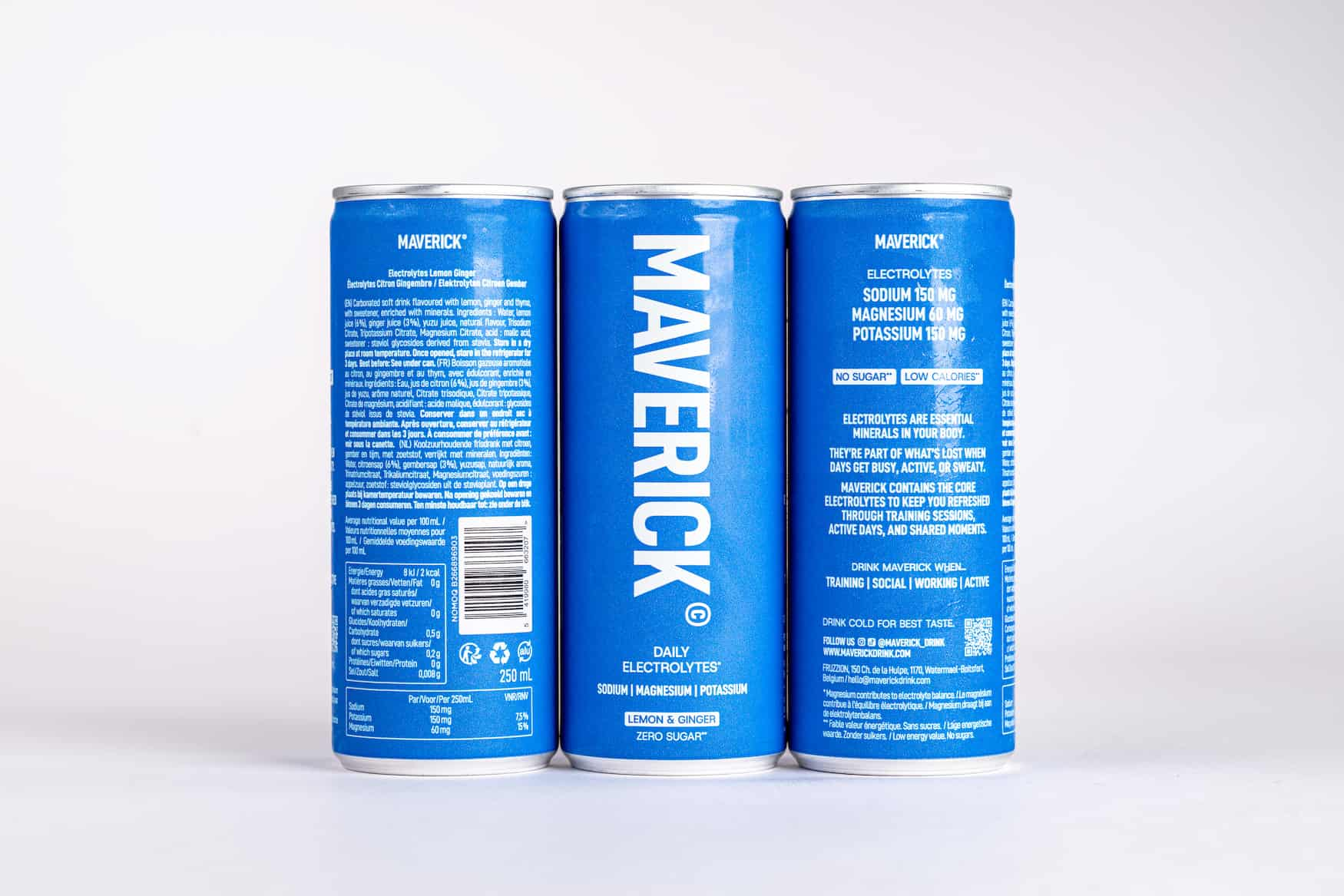
Here is our own label, read the way we just described. One can is 250 ml and is a single portion, so the per can column is what you drink.
| Label line | Per can (250 ml) | Per 100 ml | What to notice |
|---|---|---|---|
| Energy | 5 kcal | 2 kcal | Close to nothing |
| Sugars | 0.5 g | 0.2 g | 0 g added, the 0.5 g comes naturally from the juice |
| Sodium | 150 mg | 60 mg | No NRV for sodium, about 0.38 g of salt per can |
| Potassium | 150 mg (7.5% NRV) | 60 mg | Present, but below the 15% threshold |
| Magnesium | 60 mg (15% NRV) | 24 mg | Reaches the "significant amount" per portion |
| Sweetener | Steviol glycosides | Steviol glycosides | Plant based sweetener |
| Caffeine | 0 mg | 0 mg | Fine for an evening session |
That 15% is exactly why the only health claims we are allowed to make are about magnesium: it contributes to the reduction of tiredness and fatigue, to electrolyte balance and to normal muscle function. Potassium is in the can, but at 7.5% NRV we cannot claim anything about it, and we do not.
Being honest about the sodium: 150 mg is a moderate, everyday amount. For very long, very hot or very sweaty efforts, like two hours or more in the heat or a marathon, you may need more sodium than one can gives. That is why we call Maverick Daily Electrolytes: it is made for normal days, normal training and normal life. You can see the full breakdown on our electrolytes page.
Step 4: Check calories, caffeine and extras
Calories mostly follow sugar: each gram of sugar is about 4 kcal. A 500 ml bottle with 30 g of sugar lands around 120 kcal, which is fine before a long effort and a lot for a casual afternoon drink.
Then look for caffeine. In the EU, drinks with more than 150 mg of caffeine per litre (other than tea and coffee) must carry a "high caffeine content" warning. Caffeine is not bad, but it is good to know it is there, especially if you train in the evening or already had three coffees.
Finally, scan for extras: added vitamins, amino acids, herbal extracts, colourings, preservatives. None of these automatically make a drink better or worse. Ask yourself whether you actually want them, and whether the amounts are meaningful or just there to fill the front of the pack.
Step 5: Read the ingredients in order
The ingredient list is the most honest part of any label. In the EU, ingredients are listed from the largest amount to the smallest by weight. So if sugar or glucose syrup is in second place, right after water, you know what you are mostly drinking.
A few things to look for:
- Percentages: when a label highlights an ingredient (like "with real lemon"), it must state how much is in there.
- The form of the minerals: names like sodium citrate, potassium citrate or magnesium citrate tell you where the electrolytes come from.
- Length: a short list is not automatically better, but it is easier to understand.
For reference, ours reads: water, lemon juice (6%), ginger juice (3%), yuzu juice, natural flavour, trisodium citrate, tripotassium citrate, magnesium citrate, malic acid, steviol glycosides. No colourings, no preservatives, and it is vegan.
How to choose an electrolyte drink that fits your day
Once you can read the label, the choice depends on what you are doing:
- Everyday, office, short workouts, walks: water first. If you want electrolytes, a low or no sugar drink with moderate sodium is plenty.
- Long or hot sessions: look for more sodium, and some carbohydrates if you are going for hours.
- Evening training: skip the caffeine.
And remember: no electrolyte drink replaces water or food. It is a top up, not a substitute.
Next time you are standing in front of a fridge full of colourful bottles, flip one around. Sugar per serving, sweetener, electrolytes, calories and caffeine, ingredients. Thirty seconds and you know what you are getting. If a light, sparkling can with nothing to hide sounds like your thing, you can find Maverick in our shop. Either way, keep moving at your own pace.